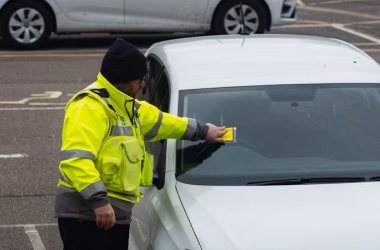
The tech services company Parka is pushing back on the media debate of recent days regarding the collection of parking fees and late-payment (penalty) charges, after the company was accused of not helping users and of charging excessive penalty fees.
Freyr Ólafsson and Þorsteinn Guðjónsson, Parka's managing director and sales director, say the company was founded first and foremost to respond to increased tourist flow and urban densification, and that the goal is to make the parking payment process as smooth as possible.
They point out that Parka handles the payment service for fees that the parking lot owners themselves set for use of their lots, and that Parka does not set the pricing. They say the company welcomes all feedback it receives about its operations.
“This is a little bit like shooting the card company over grocery store prices. We are certainly the service provider and the name people see in the parking lots, and we also answer on behalf of the lot owners — but we don't think the discussion is fair in every respect,” says Þorsteinn.
He adds that Parka is not at war with either the Consumers' Association or the Consumer Agency (Neytendastofa), which fined the company last month, among other things.
“We take the Consumer Agency's good feedback on board, have already responded to their comments together with the lot owners, and are continuing to clarify matters and improve what can be improved.”
Runólfur Ólafsson, managing director of the Icelandic Automobile Association (FÍB), told Morgunblaðið today that the parking environment has become far too complicated and that the uncertainty makes life harder for consumers.
He says in the interview that FÍB sent recommendations to the Ministry of Infrastructure for improvements in the area but without result, and is also concerned about the operation of parking apps in rural regions.
Asked whether the operation has become too complex, Freyr Ólafsson of Parka says he gets the feeling that this argument has become a cliché for many who seem to feed on negative discussion.
“Companies build their own lots and have different premises, drivers and needs. Some don't want outside visitors and set tariffs for staying or penalty fees accordingly. Others want high turnover,” says Freyr — citing medical-practice lots where owners want to deter all-day parkers through pricing, while a lower fee is charged for an “appointment stop.”
Þorsteinn says there is much that is new in the parking payment process that both companies and consumers are learning as they go. Because of differing technology, things aren't always done the same way, which can create uncertainty and misunderstanding.
“In some places drivers have to check in and out, but in others, where cameras are present, you only check in and the camera checks you out. And we have a new automatic solution that handles both — but teaching users what to do at each location can be a challenge.”
He says Parka tries to be accommodating and works to help people who get in touch and can demonstrably show that they tried to pay.
“It is not Parka's goal to charge people who were trying to pay.”
Regarding high penalty fees, Þorsteinn says technology also plays a role: in places without cameras it is impossible for wardens to know when a car was parked, and he says the benchmark has been that penalty fees are on par with a full unpaid day of parking.
“I fully understand that people are unhappy about having to pay for something they didn't pay for before. Sorpa went through something similar when charging for waste began.”
Parka says it reiterates its stance toward the feedback it receives, but notes that elements like penalty fees are used around the world as a deterrent for drivers who do not intend to pay for parking.
“We try to learn as fast and as much as we can, and we want to improve what can be improved.”
Freyr and Þorsteinn say that in a perfect world everyone would pay on the spot, but say that when payment doesn't arrive immediately, another process begins in which the company has to find the vehicle owner, look up data, file claims with the bank and more — all of which carries cost.
“We welcome all feedback and we are on the consumers' side. We try to learn as fast and as much as we can and want to improve what can be improved. We are a young Icelandic innovation company that would rather spend its energy helping, simplifying and automating than fighting internet trolls. We are trying to do all of this to the best of our ability and want to continue doing so.”
Lorem ipsum dolor sit amet, consectetur adipiscing elit, sed do eiusmod tempor incididunt ut labore et dolore magna aliqua. Ut enim ad minim veniam, quis nostrud exercitation ullamco laboris nisi ut aliquip ex ea commodo consequat. Duis aute irure dolor in reprehenderit in voluptate velit esse cillum dolore eu fugiat nulla pariatur.
Block quote
Ordered list
Unordered list
Bold text
Emphasis
Superscript
Subscript